The FAA Drone Forecast: Key Trends Shaping Commercial UAS Operations

The commercial drone industry is still growing, but the numbers are more complicated than they first appear. The FAA’s Aerospace Forecast (FAA Aerospace Forecast) and its supporting UAS compendium (FAA Compendium) examine aircraft registrations, active fleets, Remote Pilot Certificates, operator activity, waivers, large UAS, and aircraft imports. Most of the underlying data are from calendar year 2023, with projections extending through 2028. For commercial pilots, the reports offer reasons for optimism. They also contain several important cautions. A registered drone is not necessarily an active drone. A Remote Pilot Certificate does not necessarily represent a working commercial pilot. A growing fleet does not guarantee that work will be distributed evenly across the industry. Understanding those distinctions is essential when evaluating where the commercial drone market is headed.
What the FAA Is Forecasting
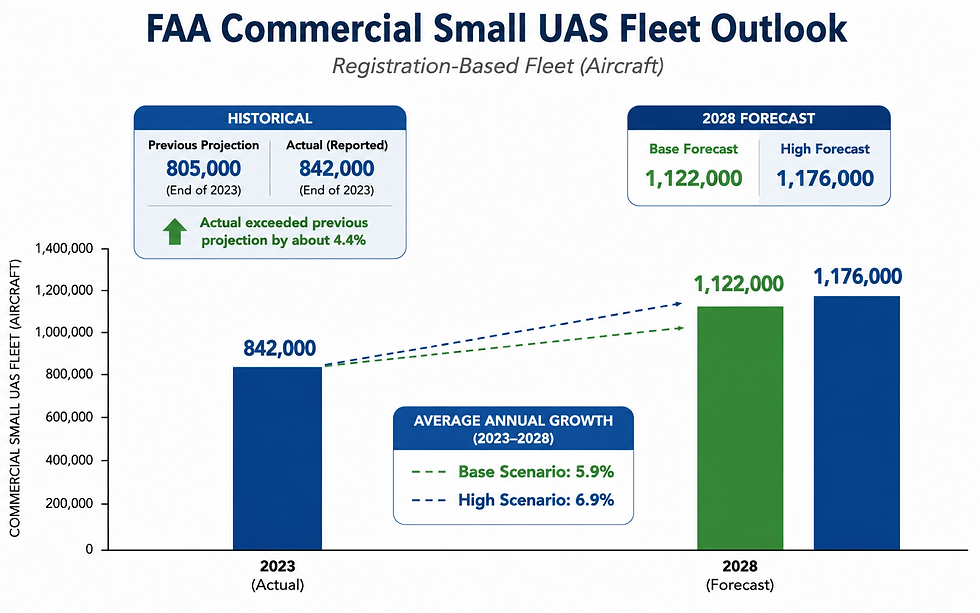
The FAA reported a registration-based commercial small UAS fleet of approximately 842,000 aircraft at the end of 2023. That exceeded the agency’s previous projection of approximately 805,000 aircraft by about 4.4%. Under the FAA’s base forecast, the commercial small UAS fleet is projected to reach approximately 1.122 million aircraft by 2028. The high forecast reaches approximately 1.176 million aircraft. The FAA calculates average annual growth of approximately 5.9% under the base scenario and 6.9% under the high scenario.
The recreational market is expected to grow much more slowly. The FAA’s base forecast increases from approximately 1.78 million recreational aircraft in 2023 to approximately 1.88 million in 2028, representing average annual growth of about 1.2%. This is one of the report’s most important conclusions. Recreational drones will remain a large part of the total fleet, but commercial operations are expected to be the stronger source of growth.
Registered Does Not Mean Active
The headline commercial fleet number requires some explanation. The FAA distinguishes between a registration-based fleet and an effective or active fleet. The registration-based forecast is largely derived from cumulative new registrations. The active fleet calculation also considers cancellations, expirations, new registrations, renewals, and registrations completed after an expiration. Using this active fleet methodology, the FAA estimated approximately 361,000 active commercial small UAS in 2023. The low forecast increases that number to approximately 374,000 by 2028. By comparison, the registration-based base forecast reaches approximately 1.122 million aircraft. That difference matters. More than 800,000 aircraft appearing in registration data does not mean that more than 800,000 aircraft are routinely conducting commercial missions. Some aircraft have expired registrations, some have been replaced, some are no longer serviceable, and others may rarely be flown.
For a drone service provider, this means the registration total can overstate the number of aircraft actively competing for work. For agencies and established companies, it also reinforces the importance of maintaining accurate fleet records instead of relying exclusively on registration totals.
Remote Pilot Numbers Continue to Grow
At the end of 2023, the FAA had issued 368,883 Remote Pilot Certificates. That was almost 64,000 more than at the end of 2022 and almost 120,000 more than in 2021. The FAA forecasts that the number of remote pilots could reach 472,269 by 2028. The report describes the difference as approximately 103,386 additional remote pilot opportunities associated with commercial and public small UAS activities. The forecast assumes that one pilot will handle an average of 2.38 commercial small UAS. Those numbers should not be interpreted as a prediction of 103,386 new full time drone jobs. A Remote Pilot Certificate is a professional credential, but many certificate holders fly drones only occasionally or use the credential as one component of a broader job in construction, engineering, surveying, public safety, utilities, or media. The more realistic conclusion is that drone proficiency will become increasingly valuable across many occupations. The pilot may not have “drone pilot” as a job title, but the ability to plan, conduct, and document a safe mission can still be an important professional skill.

Not Every Part 107 Registrant Is Commercially Active
The FAA’s 2023 operator survey provides another reason to use registration totals carefully. The survey was sent to 60,162 registrants and received responses from 26.2% of those invited. Among responding Part 107 registrants who identified their type of activity, 48.4% identified exclusively as recreational operators. Another 20.3% identified with both recreational and nonrecreational categories, while 31.3% identified exclusively as nonrecreational operators. When the FAA classified respondents according to their reported flights, 36.1% of Part 107 respondents reported recreational flights but no nonrecreational flights during 2023. Only 52.5% reported conducting at least one nonrecreational flight. This does not mean the Part 107 system is failing. A person may hold a Remote Pilot Certificate and register an aircraft under Part 107 while flying infrequently. It does mean that the number of Part 107 registrations should not be treated as the number of active drone businesses.
What Active Commercial Operations Look Like
Respondents who identified as commercial businesses or pilots for hire reported an average of 162.9 nonrecreational flights during 2023. Their average flight lasted 28.9 minutes. They reported owning an average of 5.7 aircraft and operating an average of 4.8 aircraft during the year. The average does not tell the entire story. The median commercial respondent conducted only 27 nonrecreational flights. The FAA concluded that a smaller group of frequent operators raises the average while most commercial respondents fly much less frequently. Public safety respondents reported a different fleet profile. Emergency response, public safety, and law enforcement operators averaged 142.9 nonrecreational flights, 9.7 aircraft owned, and 8.3 aircraft operated during 2023.
These findings demonstrate why fleet management, standardized training, maintenance documentation, and proficiency assessments become increasingly important as programs mature. A program operating several aircraft across several pilots has management needs that do not exist for an individual flying one aircraft a few times each year.

Aircraft Replacement Is Part of the Business
The survey also asked operators about aircraft that had been decommissioned. Nonrecreational Part 107 respondents reported owning an aircraft for an average of 3.6 years before decommissioning it, with a median ownership period of three years. Every major operator group in the survey reported a median of three years before decommissioning. That is a useful planning number for UAS program managers. A drone should not automatically be discarded after three years, but organizations should anticipate replacement costs, battery availability, sensor obsolescence, software support, repair limitations, and changing regulatory requirements. The purchase price is only part of the cost of a UAS program. Sustainable programs also budget for replacement aircraft, batteries, maintenance, software, training, insurance, and personnel time.
Photography Still Dominates the Market
The FAA report cites a Teal Group market estimate in which general photography and real estate represented 81.88% of commercial UAS aircraft in 2023. Agriculture represented 5.86%, construction represented 3.96%, energy represented 3.03%, and delivery represented only 0.07%. The FAA cautions that these figures use different definitions from its registration-based fleet estimates. Photography and real estate remain attractive because the equipment is relatively accessible and the missions can often be performed under basic Part 107 operating rules. However, a large market does not always mean a profitable market. Low barriers to entry can create intense price competition.
Specialized fields such as mapping, infrastructure inspection, thermography, utilities, construction documentation, public safety, and precision agriculture may require more training and more expensive equipment. They can also create greater value for the customer and provide stronger differentiation for the operator.
BVLOS Is Still the Pressure Point
Beyond visual line of sight operations remain one of the clearest indicators of industry demand. In 2023, BVLOS requests represented approximately 30% of operational waiver requests. Requests involving altitude limitations represented another 26%. Together, the two categories accounted for almost 56% of all waiver requests. The approval rates remained limited. The report lists an approval rate of approximately 13% for BVLOS requests and approximately 8% for requests to fly above 400 feet above ground level. Airspace authorizations increased from 24,155 in 2018 to 38,547 in 2023. Operational waivers decreased from 7,135 in 2018 to 3,574 in 2023, although they increased between 2022 and 2023.

Large UAS Growth Is Being Driven by Agriculture
The FAA also examined unmanned aircraft weighing more than 55 pounds. These aircraft are outside the normal scope of Part 107 and generally require a Section 44807 exemption or public aircraft authority. The FAA granted 1,448 Section 44807 exemptions during 2023, an increase of 245% from 2022. Approximately 77% of those exemptions, or 1,131, supported new agricultural spraying applications. The active large UAS fleet reached approximately 2,311 aircraft at the end of 2023. Subject to the continued availability of Section 44807 exemptions or an equivalent regulatory pathway, the FAA forecasts an active fleet of more than 24,000 large UAS by the end of 2028. The report therefore suggests that one of the largest near-term expansions in advanced drone operations may occur over agricultural fields rather than through urban package delivery.
The Biggest Misconceptions
The first misconception is that more than 800,000 commercial registrations represent more than 800,000 active commercial aircraft. The FAA’s effective fleet estimate was approximately 361,000 aircraft in 2023.
The second misconception is that every Remote Pilot Certificate represents an active commercial pilot. The FAA survey found that many Part 107 registrants fly exclusively or primarily for recreation.
The third misconception is that the forecast guarantees a specific number of jobs. The FAA projects growth in remote pilot opportunities, but those opportunities include commercial, public, and occupational uses in which drone operation may be only one part of a person’s responsibilities.
The fourth misconception is that the largest growth opportunities will necessarily be found in photography. Photography is currently the largest segment, but advanced operations, specialized sensors, agricultural spraying, infrastructure inspection, and BVLOS missions may offer greater opportunities for professional differentiation.
Final Thoughts
The FAA’s forecast presents a commercial drone industry that is growing, professionalizing, and becoming more operationally diverse. It also shows an industry in which a relatively small group of frequent operators conducts a substantial portion of the work. Passing the Part 107 knowledge test remains an important starting point. It is not the finish line. Commercial success increasingly requires proficiency with the aircraft, mission planning, airspace, risk management, maintenance, data processing, client deliverables, and the technical requirements of a particular industry. The commercial fleet may exceed one million aircraft, but the strongest opportunities will belong to pilots and organizations that can do more than own and register a drone. They must be able to use it safely, consistently, and in a way that creates measurable value for the customer.


Comments